Ford’s EcoBoost family has long been a cornerstone of the company’s strategy to deliver smaller displacement powerplants that do not sacrifice performance or efficiency. Among these, the 2.7L EcoBoost engine [nicknamed: Nano] has steadily carved out its niche as a versatile and robust powerplant. In this article, we explore the entire lifespan of the engine—from its debut to the refined models powering the current 2025 Ford lineup—offering an in-depth look at its evolution, design, and the passionate reviews it has inspired.
In 2015, amidst growing demands for automakers worldwide to meet stricter emissions standards without sacrificing power, Ford rose to the challenge with its EcoBoost philosophy. By integrating turbocharging and direct injection technology, Ford’s engineering team successfully created engines that delivered impressive output while significantly enhancing fuel efficiency.
The 2.7L EcoBoost V6 emerged as a product of this drive for performance and efficiency. This engine struck an ideal balance between the fuel economy of a 4-cylinder and the robust power of a V8, offering a versatile option for drivers. Since its debut, it has been incorporated into various models across Ford’s lineup, starting with the legendary F-150 and later extending to other trucks and SUVs. Thanks to the adaptability of the 2.7L EcoBoost, Ford engineers were able to customize horsepower and torque output to align with the requirements of each vehicle platform, ensuring a tailored experience for each model.
Over time, this engine has undergone numerous updates, further enhancing its power, efficiency, and reliability to meet evolving demands and expectations.
The Ford 2.7L EcoBoost V6 has garnered praise across multiple reviews for its remarkable balance of performance, efficiency, and durability. Despite its status as a smaller engine in Ford’s lineup, it delivers an abundance of torque and punch, proving itself more than capable for both everyday driving and demanding tasks. Reviewers have highlighted its smooth, confident acceleration—even when loaded with heavy towing capacities—and its ability to maintain strong performance on steep, mountainous routes without compromising fuel economy.
Many enthusiasts and experts admire the engine’s diesel-like low-end thrust paired with a spirited, gas-powered revving quality. The 2.7L EcoBoost combines turbocharged power with refined, quiet operation, ensuring that even at high speeds or under strenuous loads, it remains responsive and reliable. Even noted as the “Goldilocks” engine for being just right in power without excessive strain, it excels as a versatile option whether you’re hauling, towing, or simply enjoying the smooth drive of a well-engineered powerplant.
“Even with the small 2.7 turbo, towing is effortless; accelerating to 80mph uphill on a mountainous Interstate with 5000 lbs in boat and gear behind me is quick, such that passing a semi doesn’t incur the wrath of left lane drivers behind me.”
Source: Edmunds / Owner Review
“Far and away the thing that impressed me the most about this F-150 is this relatively low-end 2.7-liter engine. Despite its position in the hierarchy, it provides a shocking amount of punch. The truck accelerates confidently and smoothly.
So much so, I popped the hood just to make absolutely sure it really was the 2.7-liter lurking underneath. Besides offering plenty of power, it’s extremely smooth and quiet.
Source: AutoBlog
“The [2023] Ford F-150 with the 2.7L EcoBoost is an impressive feat of engineering. With its combination of diesel-inspired durability, excellent fuel economy, and surprising power output, it’s no wonder so many truck enthusiasts have been raving about it.
Whether you’re hauling, towing, or just looking for a reliable and efficient daily driver, this engine is a solid choice.”
Source: JC Whitney / Getty’s Garage
“As before, the little EcoBoost pulls forcefully from idle, its thrust feeling diesel-like—except that it revs toward its low 5750-rpm redline with gas-engine zeal.
Power is found seemingly at any rpm, although the smooth-shifting transmission wisely keeps revs low and takes advantage of the prodigious torque on tap.”
Source: Car & Driver
“The 2.7 wasn’t lacking in driver fulfillment to begin with. It’s always been a Goldilocks of an engine, with its turbochargers providing a pleasant burst of torque when you put your foot down.
Unless you’re planning on maxing out your truck’s payload or tow ratings on a regular basis, this is all the engine you need to get most jobs done.”
Source: Motortrend

The heart of the 2.7L EcoBoost engine lies in its ability to combine advanced engineering with lightweight materials, allowing for high power output with admirable efficiency. Let’s break down the specs and construction features that have defined this engine through its lifespan.
| ENGINE SPECIFICATION | VALUE |
|---|---|
| Displacement | 2.7 Liters |
| Configuration | V6 |
| Induction | Twin-Turbocharged |
| Fuel Delivery | Direct Injection |
| Block Material | Compact Graphite Iron |
| Cylinder Material | Forged Aluminum Alloy |
| Compression Ratio | 10.3:1 |
| Horsepower | 315 – 335 hp |
| Torque | 380 – 415 lb-ft |
| Redline | Approximately 6,000 rpm |
| Maximum Towing Capacity | 8,400 lbs |
In terms of raw performance, the 2.7L EcoBoost delivers between 315 and 335 horsepower and generates torque values ranging from 380 to 415 lb-ft. It revs confidently to a redline of approximately 6,000 rpm, ensuring dynamic response and robust power delivery under demanding conditions. Additionally, the engine is engineered to handle heavy-duty applications, supporting a maximum towing capacity of up to 8,400 lbs.
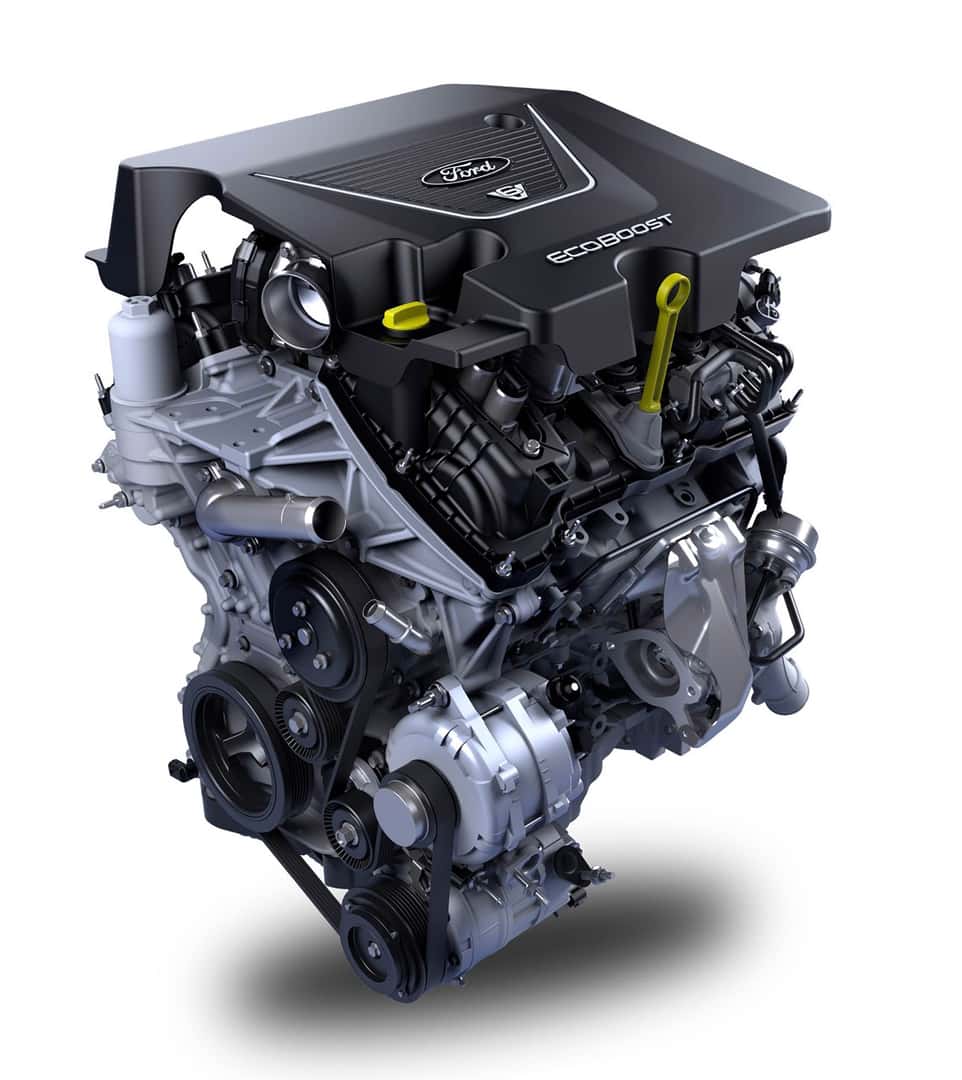
Ford’s innovative 2.7L EcoBoost engine is designed with a robust two-piece engine block comprising an upper and lower section. The upper block, constructed from compacted graphite iron—a material shared with Ford’s 3.0L and 6.7L Power Stroke engines—forms the cylinder area and incorporates fractured main bearing caps, pistons, offset I-beam connecting rods, individual piston cooling jets, and the crankshaft.
Meanwhile, the lower block features a die-cast aluminum ladder frame, bolted to the iron block and bearing caps, enhancing the engine’s overall stiffness. This aluminum ladder frame is sealed at the bottom by a composite oil pan. The assembly also integrates a front cover (IFC) that serves multiple functions, housing an integrated water pump, oil passages for cooling, an oil filter, cam phasing mechanisms, and accessory drive components, all while acting as a structural element.
The engine’s aluminum cylinder heads come equipped with water-cooled exhaust manifolds and dual overhead camshafts driven by chains. Each cylinder boasts four valves and roller finger followers, enabling efficient performance. With variable intake and exhaust camshaft timing, power output and torque are further maximized through twin turbochargers. Supporting this high-powered system is an intake setup that includes composite pipes, an air-to-air intercooler, and a composite intake manifold.
Additionally, Ford employs advanced engineering with features such as a reverse-flow cooling system, a variable-displacement oil pump, and auto stop-start functionality. Its direct fuel injection system ensures precise fuel delivery while preventing detonation, complemented by a notably high compression ratio of 10.3:1.
These technical specifications and construction features have defined the engine’s reputation as a reliable, high-performance powerplant, capable of meeting a diverse range of driving demands.
Lightweight Architecture: The use of high-grade aluminum cylinder heads is not merely about shedding weight—it’s about creating an engine that can respond quicker, reduce friction, and ultimately contribute to better fuel economy.
Advanced Turbocharging: The twin-turbo setup is engineered to deliver immediate boost response while keeping turbo lag to a minimum. Ford’s improved turbocharger calibration across successive model years has been crucial in meeting both performance and efficiency targets.
Direct Injection & Combustion Efficiency: The direct injection system ensures that fuel is delivered precisely where and when it’s needed, optimizing the air-fuel mixture for complete combustion. This not only boosts power but also lowers emissions—a core objective of the EcoBoost technology.
Reinforced Internal Components: From forged pistons to a high-strength crankshaft, each internal component is designed to withstand the demands of high-performance applications. This ruggedness makes the 2.7L EcoBoost a reliable engine for both everyday driving and heavy-duty tasks like towing.
Compact Graphite Iron (CGI) Block: Commonly utilized in heavy-duty diesel engines, this material boasts twice the tensile strength and 50% greater rigidity compared to traditional cast iron, all while being considerably lighter. This is the same material used in the 3.0L Power Stroke and 6.7L Power Stroke engines.
Offset Connecting Rods: A feature frequently seen in diesel engines, this design optimizes mechanical advantage, enhances energy transfer, and reduces friction between the pistons and cylinder walls.
Bowl-Shaped Pistons: Directly influenced by diesel engine technology, these pistons enhance fuel distribution and combustion efficiency, leading to improved torque and overall performance.
Fractured Main Caps: To ensure seamless structural integrity, the block and main bearings are initially cast as a unified piece, then strategically fractured to create an ideal fit.

| MODEL YEAR | VEHICLE MODEL | HORSEPOWER | TORQUE |
|---|---|---|---|
| 2025 | F-150 | 325 hp | 400 lb-ft |
| 2025 | Bronco | 330 hp | 415 lb-ft |
| 2025 | Ranger | 315 hp | 400 lb-ft |
| 2024 | Edge | 335 hp | 380 lb-ft |
The versatility of the 2.7L EcoBoost engine is clearly demonstrated by its broad range of applications within Ford’s lineup. Originally debuting in the F-Series trucks, this engine’s compact design and scalable output quickly led to its adoption across multiple models, proving that it’s capable of adapting to diverse performance requirements.
For instance, the 2025 Ford F-150 is equipped with a variant that produces an impressive 325 horsepower and 400 lb-ft of torque, striking a fine balance between robust power and efficiency. Equally compelling is the 2025 Bronco, which is tuned to deliver 330 horsepower and 415 lb-ft of torque—ideal for enthusiasts who demand a spirited performance in off-road situations. The 2025 Ranger also benefits from this engineering prowess, achieving 315 horsepower and 400 lb-ft of torque, further broadening the engine’s appeal in the truck segment.
Away from traditional trucks, the 2024 Ford Edge showcases the EcoBoost’s adaptability in a crossover application, offering a dynamic performance package with 335 horsepower and 380 lb-ft of torque. This infusion of power into a crossover model underlines Ford’s commitment to delivering tailored engine performance across its range, ensuring that whether you need a workhorse, an off-roader, or a versatile urban vehicle, the 2.7L EcoBoost engine meets those demands with precision and reliability.
The Ford 2.7L EcoBoost V6 engine has journeyed from a bold concept in 2015 to its current status as a refined and versatile powerplant in the 2025 Ford lineup. Its blend of innovative turbocharging, advanced direct injection, and lightweight construction not only meets but often exceeds contemporary demands for both performance and efficiency. Enthusiasts and critics alike have heralded it as a significant achievement in modern engine engineering—a true testament to Ford’s commitment to pushing the boundaries of internal combustion technology.
Whether deployed in the rugged F-Series & Ranger trucks or the latest off road SUV models, the 2.7L EcoBoost continues to embody Ford’s philosophy: do more with less, without sacrificing the performance that drivers crave. This engine not only represents a key chapter in Ford’s storied history but also sets the stage for what the future of internal combustion power may look like in a rapidly evolving automotive landscape.
In addition to its impressive technical prowess and positive reviews, the 2.7L EcoBoost story invites enthusiasts to consider broader questions about the future of combustion engines. How will next-generation materials and connectivity further enhance these powerplants? What lessons can be drawn from Ford’s continual refinements in balancing performance with environmental responsibility?
The narrative of the Ford 2.7L EcoBoost engine is far from over. As Ford addresses the evolving challenges of emission regulations, sustainability, and consumer expectations, the legacy of this engine will likely serve as a technical and philosophical stepping stone toward even bolder innovations in the world of performance engines.
Choosing the Ford F-150 equipped with the 2.7L EcoBoost engine is a smart decision for those who value exceptional performance, efficiency, and reliability. This engine delivers robust power and torque, ensuring effortless towing and smooth acceleration, even under heavy loads. Its advanced engineering—combining turbocharging, direct injection, and lightweight construction—means you get the perfect balance of high output and fuel economy, making it an ideal choice for both work and daily driving.
If you’re ready to experience the unmatched versatility and power of the 2.7L EcoBoost in the Ford F-150, visit JC Lewis Ford in Savannah, GA. Discover firsthand why this engine is celebrated by enthusiasts and experts alike, and drive away in a vehicle that truly exceeds expectations.