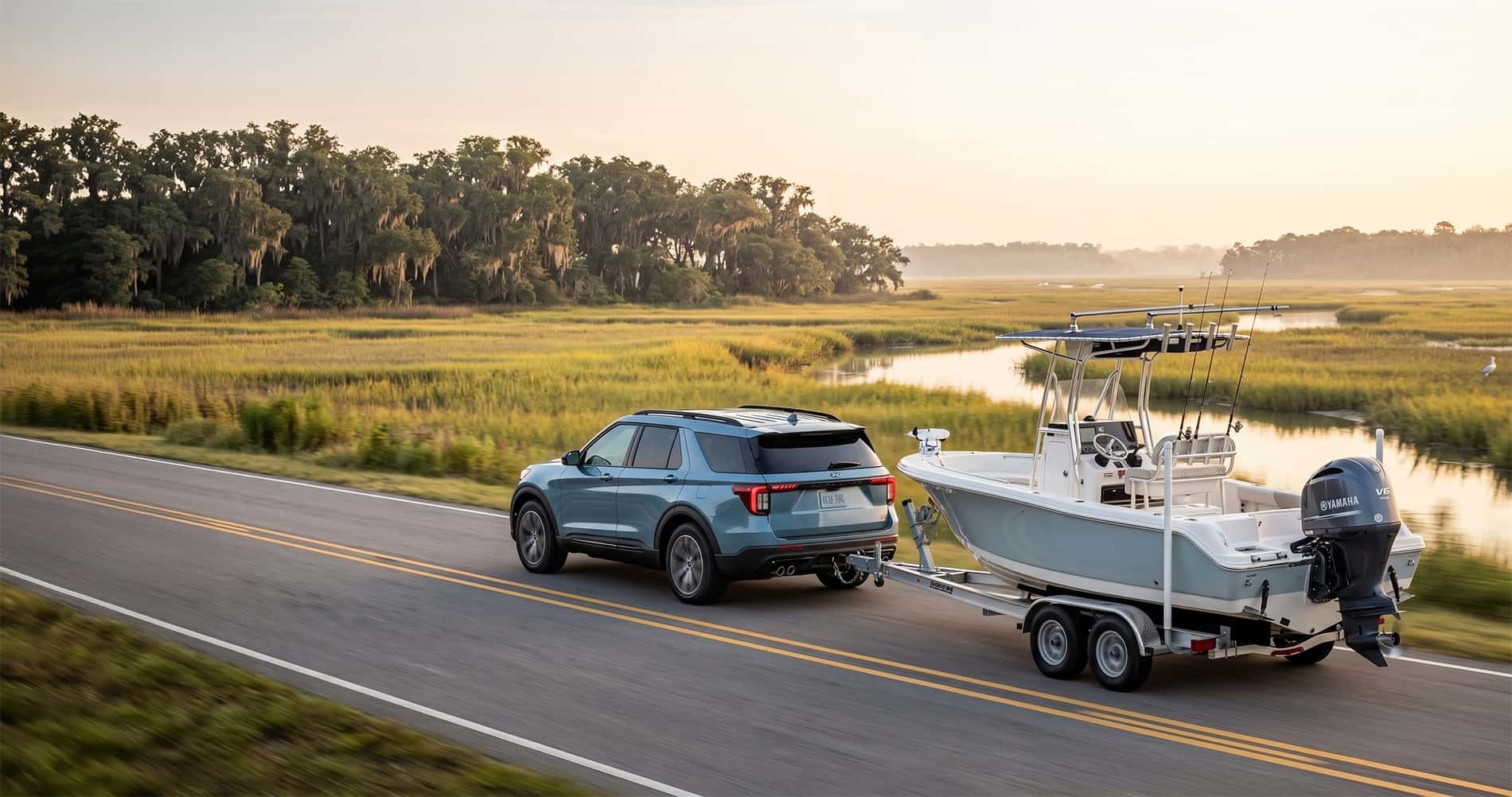
The 2026 Ford Explorer is built to handle more than just the daily drive—and for a lot of drivers, that includes towing. Whether it’s a boat for the weekend, a trailer for a project, or gear for a longer trip, capability matters. The key is understanding not just how much the Explorer can tow, but how it handles that weight once it becomes part of your routine.
Across the lineup, the Explorer delivers a consistent 5,000-lb towing capacity when properly equipped. That keeps the decision simple on paper. What actually shapes ownership is how engine choice, drivetrain, and towing setup affect the way the vehicle feels when it’s loaded down and on the move.
In this guide, we break down the 2026 Ford Explorer towing capacity in real terms. You’ll see how the numbers translate into everyday use, what impacts towing performance, and how to choose the right setup based on how you plan to use your SUV around Savannah, Bluffton, Beaufort, and across the Coastal Lowcountry.
The 2026 Explorer earned the IIHS Top Safety Pick+
, the highest safety rating awarded by the Insurance Institute for Highway Safety. This recognition reflects top-tier crash protection, advanced driver-assistance technology, and strong performance in updated side-impact testing.
Why it matters:
2026 Ford Explorer
8 / 10 Rating
Ranked among the top midsize SUVs on the market, Car & Driver highlights the Explorer’s well-rounded performance, noting its strong capability across the lineup—including a 5,000-lb towing capacity that holds steady across configurations.
That consistency is exactly what makes the Explorer appealing for drivers who want one SUV that handles everyday life and towing without compromise.
| 2026 Ford Explorer Towing Capacity by Engine & Drivetrain | |||
|---|---|---|---|
| Engine | Drivetrain | Max Towing Capacity* (Lbs.) | GCWR* (Lbs.) |
| 2.3L EcoBoost I4 | RWD | 5,000 | 10,000 |
| 2.3L EcoBoost I4 | 4WD | 5,000 | 10,100 |
| 3.0L EcoBoost V6 | RWD | 5,000 | 10,800 |
| 3.0L EcoBoost V6 | 4WD | 5,000 | 10,800 |
The key takeaway here is straightforward: every 2026 Ford Explorer is rated to tow 5,000 lbs when properly equipped, so your decision isn’t about whether it can tow—it’s about how it handles towing once it becomes part of your routine.
That’s where the difference between the 2.3L EcoBoost I4 and the 3.0L EcoBoost V6 starts to matter. On paper, they land at the same towing number. In practice, the higher GCWR of the 3.0L V6—up to 10,800 lbs—gives it more headroom when the vehicle is loaded with passengers, gear, and a trailer all at once. That shows up over time, especially on longer drives, highway merging, and pulling through elevation changes.
The 2.3L engine still fits a lot of real-life use. It handles boats, utility trailers, and small campers without issue, and it keeps the Explorer feeling lighter and more efficient during everyday driving around Savannah or running errands through Bluffton.
The 3.0L V6 fits a different kind of ownership. It makes more sense for drivers who tow more often or travel farther with a trailer, or regularly load the vehicle up before heading out toward places like Hilton Head or Beaufort.
So the decision becomes simple:
Both get the job done. One just gives you more margin when it matters.
| 2026 Ford Explorer Standard Trailer Tow Package | |
|---|---|
| Equipment | Explorer |
| 7-Wire Harness & 4-/7-Pin Connector | Included |
| Class III Hitch Receiver | Included |
| Tow/Haul Mode | Included |
| Trailer Sway Control | Included |
| Lane Keeping Alert* | Included |
What this table really shows is that the 2026 Ford Explorer comes ready to tow in a way that feels complete from the start—not pieced together after the fact.
This isn’t just about having a hitch bolted on. The Explorer is set up so everything works together the moment you hook up a trailer. The wiring is already in place, the connection points are straightforward, and the vehicle recognizes that you’re towing and adjusts how it drives.
That shows up most in how smooth everything feels once you’re moving. Tow/Haul Mode keeps the Explorer from constantly shifting when you’re pulling weight, so acceleration feels more controlled and predictable. It’s the kind of thing you notice merging onto a busy road or getting up to speed without the vehicle feeling like it’s working too hard.
Stability matters just as much as power, and that’s where Trailer Sway Control earns its place. When conditions aren’t perfect—wind, uneven pavement, traffic—it helps keep the trailer settled so the whole setup feels composed instead of reactive.
Even features like Lane Keeping Alert start to matter more once you’re towing. Longer drives require more focus, and having that extra layer of awareness helps keep everything consistent mile after mile.
The result is simple: the Explorer doesn’t just meet towing requirements—it feels like it was designed to handle them in real use, not just on paper.
| 2026 Ford Explorer Towing Limits & Hitch Receiver Capacity | |
|---|---|
| Specification | Figure |
| Maximum Trailer Frontal Area With Trailer Tow Package* | 40 Sq. Ft. |
| Factory-Installed Hitch Receiver Max Trailer Capacity | 5,000 Lbs. |
| Factory-Installed Hitch Receiver Max Tongue Load* | 500 Lbs. |
| Hitch Receiver Application | Explorer Gas Or Hybrid |
This is the table that clears up where the real limits are—not just what the Explorer can tow, but how that towing needs to be set up to feel right on the road.
The 5,000-lb rating lines up with what you’d expect, but the 500-lb tongue weight is what actually keeps everything balanced. That’s the downward force on the hitch, and when it’s set correctly, the trailer tracks cleanly behind you instead of shifting or feeling unsettled. You don’t think about it when it’s right—but you feel it immediately when it’s not.
The 40 sq. ft. frontal area number is one most buyers haven’t seen before, but it matters more than it sounds. It’s about wind resistance. A low-profile trailer, like a boat or small utility trailer, moves through the air easily and lets the Explorer tow smoothly. Taller, boxier trailers create more drag, which can change how the vehicle accelerates, brakes, and holds speed over distance.
What this comes down to is matching the setup, not just the weight:
That’s how the towing experience stays consistent—not just capable, but controlled from the first mile to the last.
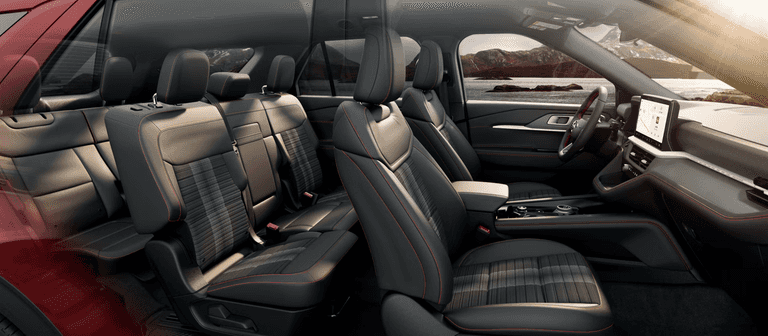
The 2026 Ford Explorer keeps towing straightforward in a way that actually helps you make a decision. Every model is built to handle up to 5,000 lbs when properly equipped, so you’re not trying to “unlock” capability by jumping trims—if you want a deeper breakdown of how each version is positioned, you can explore the 2026 Ford Explorer models. The real question is how often you plan to tow and how much you’ll be carrying at the same time.
☑︎ For occasional towing—small boats, utility trailers, or weekend trips—the 2.3L EcoBoost keeps things simple while still giving you full capability without overcommitting to more engine than you need.
☑︎ If your trips include passengers, gear, and longer highway drives, the 3.0L EcoBoost V6 adds stability and headroom so the vehicle feels more composed under load.
☑︎ When towing becomes part of your routine, the Trailer Tow Package is what makes everything feel controlled instead of reactive, especially in traffic or changing road conditions.
☑︎ Lower-profile trailers tend to match the Explorer best, keeping the drive smoother and more predictable over distance.
☑︎ A properly balanced setup, including staying within the 500-lb tongue weight, is what keeps towing feeling steady mile after mile.
What stands out about the Explorer is how naturally it fits the towing needs across the Lowcountry. It moves through everyday driving without feeling oversized, then steps confidently into towing when you need it. That balance makes it a practical choice for drivers who don’t want a dedicated tow vehicle, but still rely on real capability when it counts.
At J.C. Lewis Ford of Savannah, we help you see where the Explorer’s towing capability fits into everyday life in Savannah, Bluffton, Beaufort, and across Coastal Georgia.
After serving Savannah, Hilton Head, and Hardeeville for over 110 years, we’ve seen exactly how people in the Lowcountry use their vehicles—and towing is a big part of that story. If you want to understand more about how we’ve built that reputation over time, you can learn more about J.C. Lewis Ford of Savannah and how we work with local drivers every day.
Most of the time, it starts with a center console boat that needs to get to the water early, a trailer loaded up for a weekend project, or gear packed in the back for a longer trip down the coast.
That’s where the right Explorer setup makes the difference. Some drivers want something that tows a few times a month and stays smooth the rest of the week. Others load up passengers, gear, and a trailer all at once and expect it to stay composed over longer drives. We’ve worked through both, and we know how those details show up once you’re actually on the road.
We walk through what matters before you ever hook anything up—how the vehicle will feel under load, how it handles different conditions, and which setup makes the most sense for how you plan to use it. The goal is simple: when it’s time to tow, everything feels natural and predictable.
We’d be happy to help you find the right Explorer and welcome you into the J.C. Lewis family. You can explore current inventory here or stop in and take one for a drive.
DISCLAIMERS:
*Towing capacity shown is maximum when properly equipped. Maximum towing varies based on cargo, vehicle configuration, accessories, and number of passengers.
*Combined weight of vehicle and trailer must not exceed Gross Combined Weight Rating (GCWR).
*Maximum tongue weight and hitch capacity must not be exceeded. Always use proper towing equipment and setup.
*Trailer frontal area should not exceed 40 sq. ft. when equipped with the Trailer Tow Package. Exceeding this limit may reduce towing performance.
*EPA-estimated mileage. Actual results will vary based on driving conditions, vehicle maintenance, and driving habits.
*Driver-assist features are supplemental and do not replace the driver’s attention, judgment, and need to control the vehicle.
*See your dealer for complete details on towing equipment, capacity, and specifications.