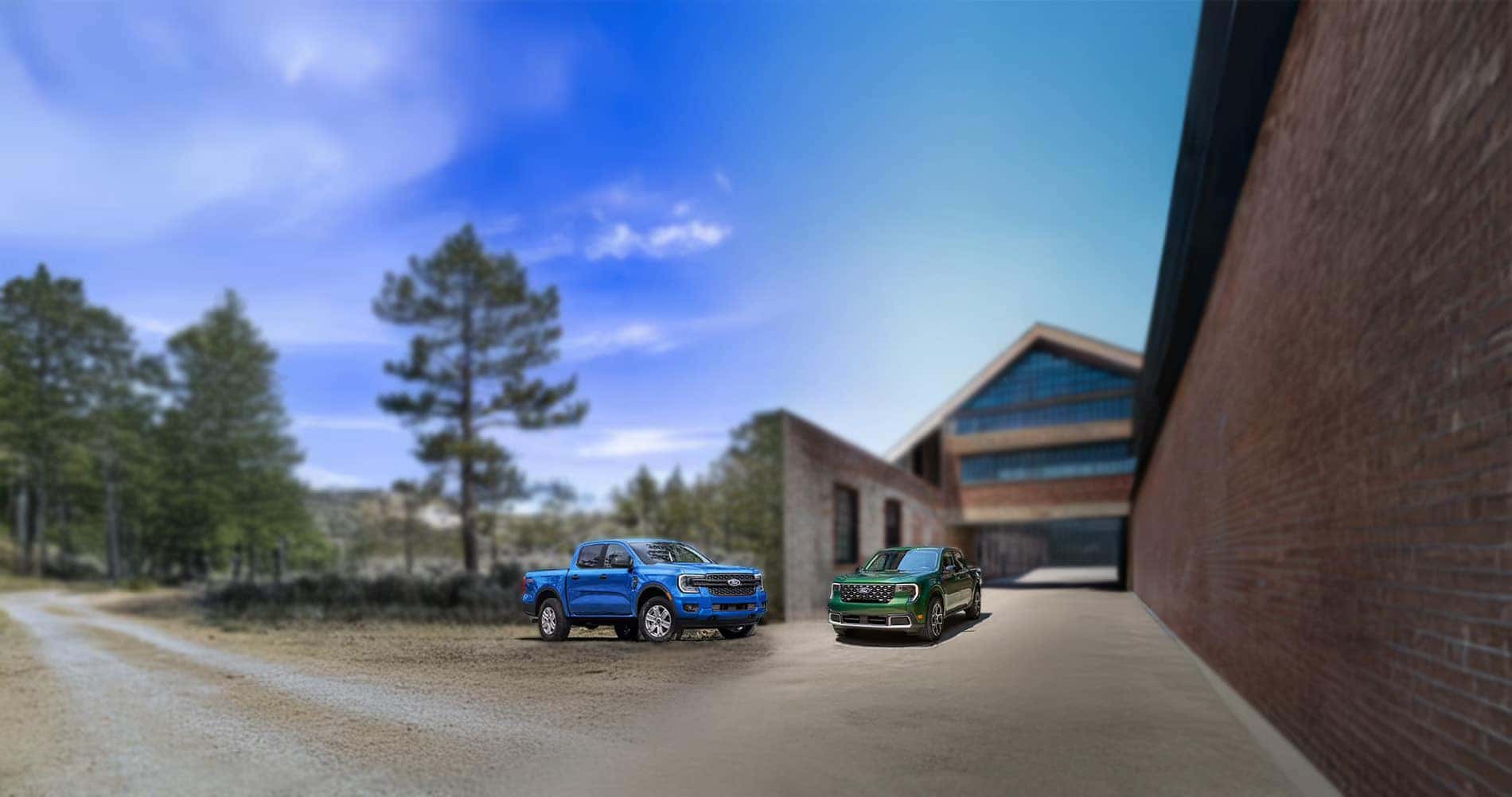
Perfect, you’re trying to decide between a Ford Maverick vs Ranger – luckily, our deep‐dive comparison of these two Ford trucks will help make the process easier to process!
WE’LL BE FOCUSING PRIMARILY ON THE:
2025 Ford Maverick Lariat SuperCrew with the 2.0L EcoBoost AWD
vs
2025 Ford Ranger XL SuperCrew with the 2.3L EcoBoost 4×4
This configuration of the Maverick has been a favorite among consumers & among the most popular trims on the road. We have chosen the Ranger model that is comparably priced to the Maverick since people typically have a price point that they would like to stay within. Choosing a $5,000 – $10,000 more costly trim for the Ranger just didn’t quite make sense to us.
While the Maverick has earned accolades for its clever, urban‐friendly design and modern amenities, many buyers are curious if stepping up to the traditionally rugged Ranger is worth the change. In this article, we’ll explore everything from pricing and overall value to design, performance, utility, interior technology, and safety features. The goal is to help you understand how each truck fits into daily life—whether you need an agile city pickup for weekend errands or a robust companion for heavier-duty endeavors.
The value proposition of these two 2025 models lies in their nearly identical price points while catering to distinctly different lifestyles. This near parity in pricing might seem counterintuitive given that the Ranger is built on a traditional body-on-frame platform with a more powerful engine and arguably a “tougher” image – however, the Maverick excels in its class – all while being better equipped technologically and with a higher level comfort. The better value comes down to what you require most from your pickup.
The 2025 Ford Maverick Lariat SuperCrew with the 2.0L EcoBoost AWD at $37,290 MSRP* offers a refined, urban-friendly experience. It combines agile, efficient performance with advanced technology and a premium interior—ideal for drivers seeking a sophisticated, tech-heavy ride that excels in daily commutes and suburban driving.
The 2025 Ford Ranger XL SuperCrew with the 2.3L EcoBoost 4×4 at $36,725 MSRP* is built for durability and rugged performance. Its body-on-frame design, enhanced power, and off-road capabilities make it perfect for those who need a work-ready truck that can handle heavy towing, challenging terrain, and more demanding environments.
The real value comparison reveals a story of differing priorities and market positions. Together, they present compelling choices: one for modern luxury and efficiency, and the other for robust, heavy-duty capability.
+ ANSWERING
| Specification | Ford Maverick 2.0L EcoBoost AWD (Lariat) | Ford Ranger 2.3L EcoBoost 4×4 (XL) |
|---|---|---|
| Lift in Height | 29.4 inches | 34.7 inches |
| Pickup Body Length at Floor | 54.4 inches | 59.6 inches |
| Cargo Width – Wheelhouse | 42.6 inches | 48.2 inches |
| Exposed Cargo Width (Maximum Width) | 53.3 inches | 62.4 inches |
| Cargo Volume | 33.3 cubic feet | 43.5 cubic feet |
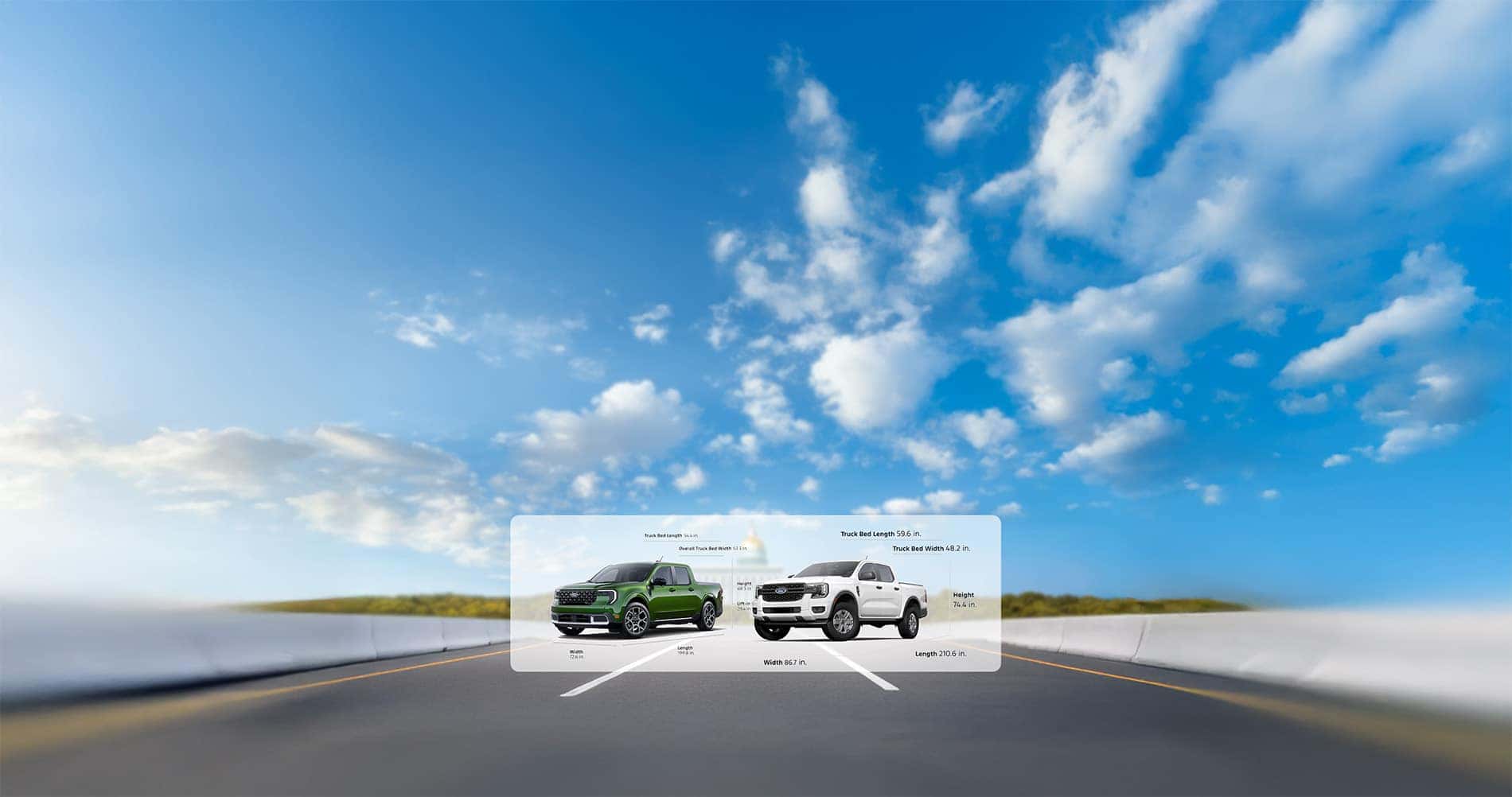
When you’re asking “ What is the bed size on Ford Ranger and Maverick ” — the key differences show up in both height and length. The Ford Maverick Lariat equipped with the 2.0L EcoBoost AWD has a lift height of 29.4 inches, while the Ranger XL with the 2.3L EcoBoost 4×4 sits taller at 34.7 inches. Looking at the pickup body length at floor, the Maverick measures 54.4 inches from cab to tailgate floor, whereas the Ranger extends that to 59.6 inches, giving you an extra five inches of flatbed floor space in the Ranger.
When comparing Ford Maverick vs Ranger size in terms of width and volume, the Maverick’s cargo area between the wheelhouses is 42.6 inches wide, compared to 48.2 inches in the Ranger — almost six inches more usable width. If you need maximum bed width, the Maverick opens up to 53.3 inches, but the Ranger stretches that to 62.4 inches at its widest point. Finally, the Maverick’s bed holds 33.3 cubic feet of cargo, while the Ranger’s larger dimensions translate to 43.5 cubic feet, offering a full 10.2 additional cubic feet for hauling gear, tools, or weekend toys.
| Specification | Ford Maverick 2.0L EcoBoost AWD (Lariat) | Ford Ranger 2.3L EcoBoost 4×4 (XL) |
|---|---|---|
| Overall Length | 199.8 inches | 210.6 inches |
| Height | 68.5 inches | 74.4 inches |
| Body Width | 72.4 inches | 75.5 inches |
| Width w/ Mirrors | 83.5 inches | 86.7 inches |
| Wheelbase | 121.1 inches | 128.7 inches |
| Track Front/Rear | 63.5 / 62.6 inches | 63.8 / 63.8 inches |
| Ground Clearance | 8.3 inches | 9.3 inches |
| Curb Weight | 3,563 pounds | 4,415 pounds |
| Wheel & Tire Size | 19-Inch Wheels 225/55 R19 Tires |
17-Inch Wheels 255/70 R17 A/T Tires |
When comparing the 2025 Ford Maverick vs Ranger size in exterior dimensions, the Maverick Lariat equipped with the 2.0L EcoBoost AWD measures an overall length of 199.8 inches, contrasting with the Ranger XL’s 210.6 inches. The Maverick stands 68.5 inches tall versus the Ranger’s 74.4 inches. Body width spans 72.4 inches on the Maverick and expands to 83.5 inches with mirrors, while the Ranger measures 75.5 inches body width and 86.7 inches including mirrors. Wheelbase and track dimensions further illustrate the size gap: the Maverick has a 121.1-inch wheelbase with 63.5- and 62.6-inch front/rear track, compared to the Ranger’s 128.7-inch wheelbase and 63.8-inch tracks front and rear.
On off-road capability and carrying capacity, Ford Maverick vs Ranger size differences are just as clear. Ground clearance comes in at 8.3 inches for the Maverick and 9.3 inches for the Ranger. Curb weight reflects their class divide: the Maverick tips the scales at 3,563 pounds, while the Ranger weighs in at 4,415 pounds. Wheel and tire setups underscore each truck’s intent, with the Maverick riding on 19-inch wheels wrapped in 225/55 R19 tires and the Ranger rolling on 17-inch wheels fitted with 255/70 R17 all-terrain tires.
| Interior Dimension | 2025 Ford Maverick Lariat SuperCrew | 2025 Ford Ranger XL SuperCrew |
|---|---|---|
| Seating Capacity | 5 Passengers | 5 Passengers |
| Passenger Volume | 101.5 cubic feet | 98.3 cubic feet |
| Front Headroom | 40.2 inches | 39.8 inches |
| Rear Headroom | 39.6 inches | 38.3 inches |
| Front Legroom (Maximum) | 42.8 inches | 43.7 inches |
| Rear Legroom | 36.9 inches | 34.6 inches |
| Front Hip Room | 55.4 inches | 55.9 inches |
| Rear Hip Room | 54.1 inches | 54.1 inches |
| Front Shoulder Room | 57.3 inches | 57.1 inches |
| Rear Shoulder Room | 55.6 inches | 56.7 inches |
When comparing Ford Maverick vs Ranger size on the inside, both SuperCrew models seat five comfortably, but the Maverick edges ahead in overall passenger volume with 101.5 cubic feet versus the Ranger’s 98.3 cubic feet. Front headroom is nearly identical, at 40.2 inches in the Maverick and 39.8 inches in the Ranger, while rear passengers benefit from 39.6 inches of headroom in the Maverick compared to 38.3 inches in the Ranger. Legroom tells a similar story: the Maverick offers up to 42.8 inches up front and 36.9 inches in the rear, whereas the Ranger provides slightly more front legroom at 43.7 inches but less rear legroom at 34.6 inches.
Ford Maverick vs Ranger size differences also show up in hip and shoulder measurements. Front hip room is essentially neck-and-neck, with 55.4 inches in the Maverick and 55.9 inches in the Ranger, and both deliver 54.1 inches of rear hip room. Shoulder room flips the balance in the Ranger’s favor in the rear—56.7 inches compared to the Maverick’s 55.6 inches—while the front seats are marginally wider in the Maverick at 57.3 inches versus the Ranger’s 57.1 inches.
| Specification | Ford Maverick Lariat | Ford Ranger XL |
|---|---|---|
| Chassis Type | Unibody | Body-On-Frame |
| Engine Type | 2.0L EcoBoost (Turbocharged) 4-Cylinder | 2.3L EcoBoost (Turbocharged) 4-Cylinder |
| Engine Power | 238 hp | 270 hp |
| Torque | 275 pound-feet | 310 pound-feet |
| Transmission | 8-Speed Automatic | 10-Speed SelectShift® Automatic |
| Drive Type | All-Wheel Drive
(Available Front-Wheel Drive on Hybrid) |
4×4
(Available 4×2) |
| Miles Per Gallon* | 22 City / 30 Highway | 21 City / 26 Highway |
| Fuel Tank Size | 16.5 gallons | 18.7 gallons |
| Engine Oil Capacity | 5.5 quarts | 5.7 quarts |
| Towing Capacity | 2,000 pounds*
(4k lbs. With Tow Package) |
7,500 pounds* |
| Payload | 1,500 pounds* | 1,711 pounds* |
| GVWR | 5,320 pounds | 6,170 pounds |
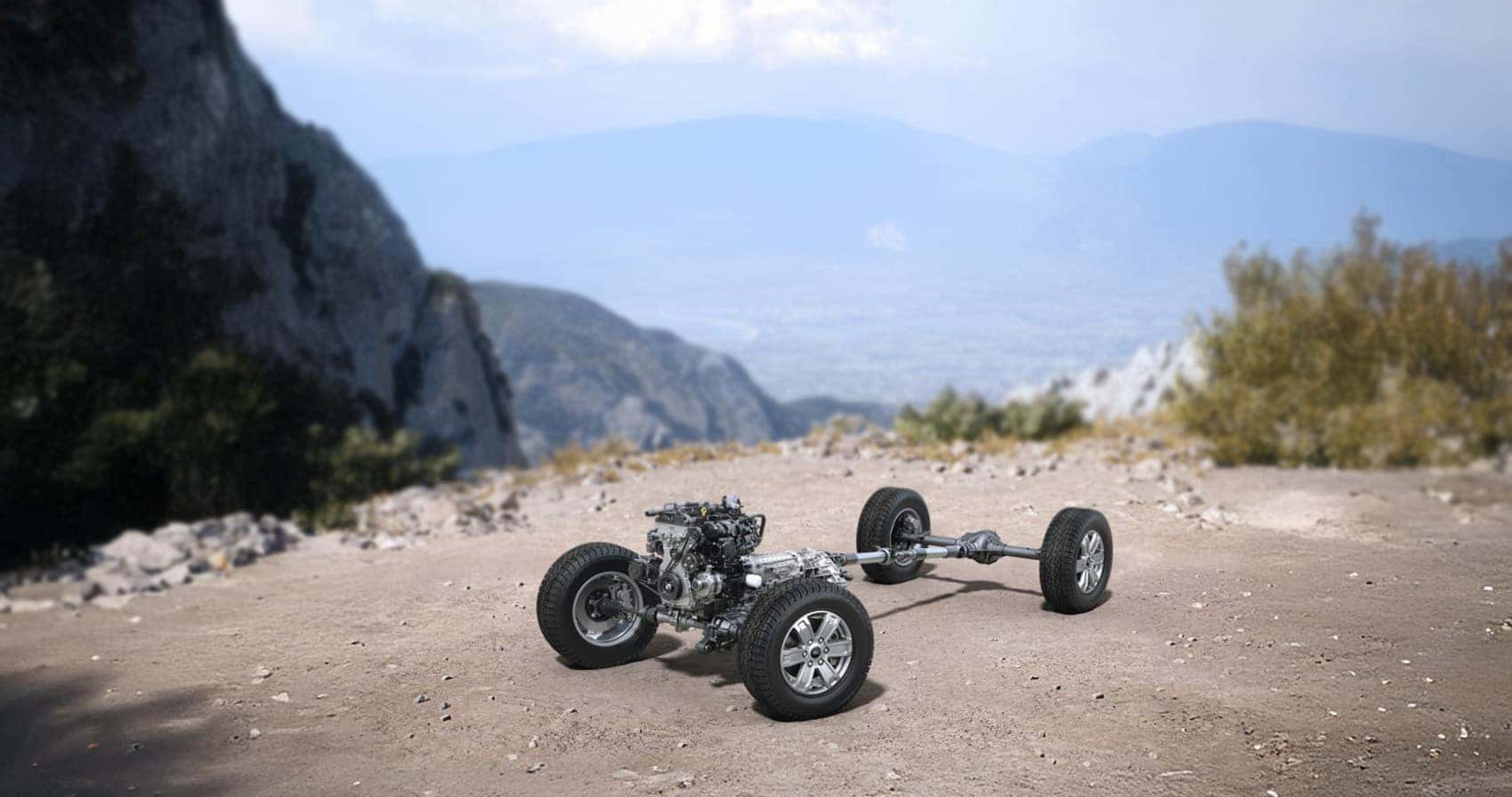
Ford Maverick vs Ranger specs reveal two very different truck architectures tailored to distinct driving needs. The Maverick Lariat rides on a unibody chassis that delivers car-like handling and efficiency, powered by a 2.0-liter EcoBoost turbocharged four-cylinder engine putting out 238 horsepower and 275 pound-feet of torque. It pairs with an eight-speed automatic transmission and standard all-wheel drive (with front-wheel drive available on the hybrid), returning an EPA-estimated 22 mpg in the city and 30 mpg on the highway*.
By contrast, the Ranger XL utilizes a traditional body-on-frame construction built for durability, driven by a larger 2.3-liter EcoBoost turbo-four that cranks out 270 horsepower and 310 pound-feet of torque through Ford’s 10-speed SelectShift® automatic transmission and standard 4×4 system (with 4×2 and an electronic-locking rear axle available). The Ranger’s heavier-duty setup trades a bit of efficiency for capability, achieving 21 mpg city and 26 mpg highway* and carrying a larger 18.7-gallon fuel tank and 5.7-quart oil capacity versus the Maverick’s 16.5-gallon tank and 5.5-quart oil capacity.
When it comes to hauling and towing prowess, Ford Maverick vs Ranger specs diverge even more sharply. The Maverick Lariat serves as an agile urban workhorse with a 2,000-pound towing capacity (upgradeable to 4,000 pounds with an available tow package), a 1,500-pound payload rating, and a gross vehicle weight rating (GVWR) of 5,320 pounds. The Ranger XL ups the ante for serious tasks, boasting a 7,500-pound towing capacity, a 1,711-pound payload, and a GVWR of 6,170 pounds. Whether you prioritize daily efficiency or heavy-duty capability, the Ford Maverick vs Ranger specs clearly lay out the trade-offs between nimble versatility and rugged strength.
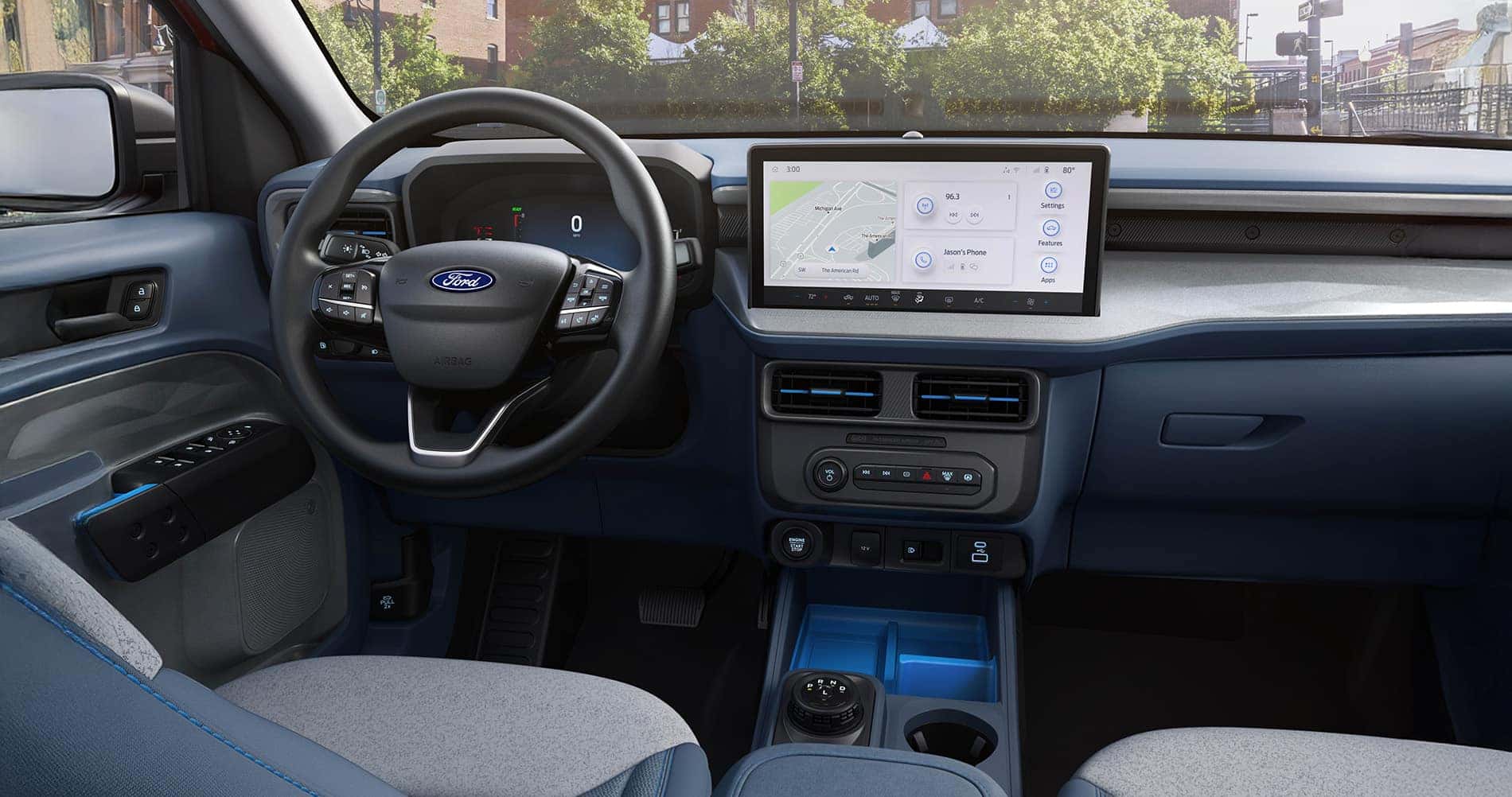
When evaluating Ford Maverick vs Ranger specs in equipment, the Maverick Lariat delivers a surprisingly upscale package for its size. On the outside, you get gloss-black accents, painted mirrors, body-color door handles, and a spray-in bedliner with Flexbed® system, 10 tie-down points, cubby storage, and power-locking tailgate. Inside, premium ActiveX-trimmed seats with power adjustment and heating, dual-zone climate control, wireless charging, ambient lighting, and a 13.2-inch SYNC 4 touchscreen paired with a Bang & Olufsen sound system set the Maverick apart. It also includes the full suite of Co-Pilot360® safety tech plus a 360-degree camera with trailer-reverse guidance.
By comparison, the Ranger XL leans into its utilitarian roots with robust, no-nonsense gear optimized for work and off-road readiness. Its exterior features black-finish trim, basic wheel-lip moldings, front tow hooks, and cargo-box tie-downs. The interior centers on durable cloth seats, single-zone manual A/C, and SYNC 4A on a 10-inch display backed by six standard speakers. Convenience is handled via straightforward power windows and locks, a 12-volt outlet, and FordPass® Connect, while safety is anchored by Co-Pilot360® essentials like auto high-beams, lane departure warning, and rearview camera. In short, the Maverick Lariat toys with premium comfort and tech, whereas the Ranger XL equips you with all the hard-use necessities.
| Category | Ford Maverick Lariat Features | Ford Ranger XL Features |
|---|---|---|
| Appearance |
|
|
| Towing & Hauling |
|
|
| Windows & Glass |
|
|
| Lighting |
|
|
| Category | Ford Maverick Lariat Features | Ford Ranger XL Features |
|---|---|---|
| Seating |
|
|
| Climate |
|
|
| Entertainment Systems |
|
|
| Comfort & Convenience |
|
|
| Category | Ford Maverick Lariat Features | Ford Ranger XL Features |
|---|---|---|
| Safety Features |
|
|
| Co-Pilot360® Technology |
|
|

In this comparison of Ford Maverick vs Ranger Specs — we broke down how each model’s features stack up. From towing capacity to cabin technology, the Ford Maverick vs Ranger Specs guide you through the essentials you need to make the right choice for city commutes or rugged workdays. By focusing on key performance metrics, comfort amenities, and safety systems, this Ford Maverick vs Ranger Specs overview sets the stage for deeper exploration of each truck’s strengths.
If you’re evaluating Ford Maverick vs Ranger Specs with an eye toward daily driving ease, the Maverick Lariat stands out. The Ford Maverick vs Ranger Specs show the Maverick excels in:
These Ford Maverick vs Ranger Specs illustrate why city dwellers and small families will appreciate the Maverick’s car-like ride, upscale ActiveX™ seats, dual-zone climate control, and premium sound system.
When reviewing Ford Maverick vs Ranger Specs for heavy hauling or off-road use, the Ranger XL claims its territory. Key Ford Maverick vs Ranger Specs for the Ranger XL include:
These Ford Maverick vs Ranger Specs confirm the Ranger XL as a go-to workhorse for contractors, outdoor enthusiasts, and those who need a truck built on a body-on-frame platform.
Comparing Ford Maverick vs Ranger Specs boils down to how you plan to use your truck. If daily comfort, connectivity, and light towing top your list, the Maverick Lariat’s balance of efficiency and tech edges out. If demanding work, serious towing, and off-road capability are your priorities, the Ranger XL’s rugged design and higher payload capacity deliver exactly what you need.
Both trucks carry the Ford DNA of durability and modern technology, yet they satisfy distinct needs. Whether you gravitate toward the sleek, efficient Maverick for everyday urban life or find the Ranger’s robust capabilities a better match for your adventurous or demanding lifestyle, Ford has crafted versatile solutions that don’t force you to compromise on either comfort or capability.
Whatever your final decision may be, understanding these nuances will help ensure that you invest in a truck that feels as right for your daily drive as it does for your weekend getaways.
Should you have lingering questions about how these trucks operate in different climates or over varying terrains, consider scheduling a test drive today at JC Lewis Ford in Savannah, Georgia.
Listening to the engine cadence, feeling the ride quality, and exploring the digital interface firsthand can often help cement which truck ultimately fits into your life both practically and emotionally.
Enjoy the journey toward your perfect Ford – Happy driving!
DISCLAIMERS:
*Current Manufacturer Suggested Retail Price (MSRP) for base vehicle. Excludes destination/delivery fee plus government fees and taxes, any finance charges, any dealer processing charge, any electronic filing charge, and any emission testing charge. Optional equipment not included. Starting A/X/Z Plan price is for qualified, eligible customers and excludes document fee, destination/delivery charge, taxes, title and registration. Not all vehicles qualify for A/X/Z Plan:
*When properly equipped. Max towing varies based on cargo, vehicle configuration, accessories, and number of passengers.
*Max payload varies and is based on accessories and vehicle configuration. See label on doorjamb for carrying capacity of a specific vehicle. Always properly secure cargo.
*EPA-estimated rating – actual mileage will vary.