Which Full-Size Pickup Fits Coastal Georgia Drivers Better?
More Capability & Configuration Choice or Tundra Ride Comfort & Standard Composite-Bed Utility? The Better Fit Depends on How You Use Your Truck.
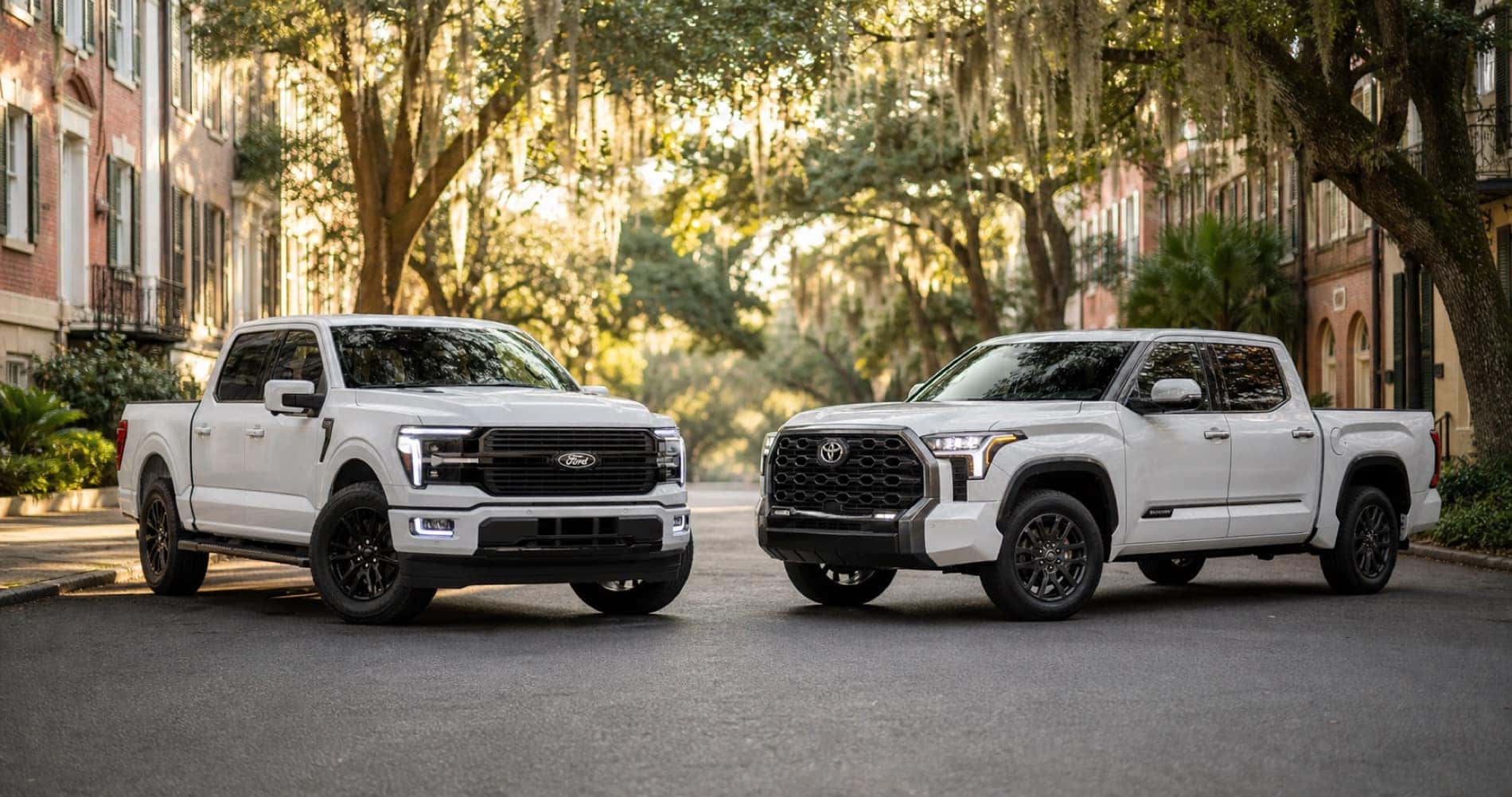
The 2026 Ford F-150 and Toyota Tundra solve the same full-size pickup jobs with different priorities. The F-150 leans into configurability, giving shoppers more cab, engine, work-utility, luxury, and specialty routes. The Tundra concentrates its lineup around twin-turbo V6 power, a standard composite bed, a coil-spring rear suspension, and an available high-output hybrid.
That difference matters around Coastal Georgia because the same truck may need to handle weekday tools or cargo, a boat or jet-ski trailer, bridge and I-95 travel, family passengers, and a weekend run toward the river, beach, or Lowcountry. The right answer depends less on which truck has the longest feature list and more on which configuration solves the jobs you repeat.
The most useful comparison is not headline maximum against headline maximum. It is whether the exact cab, bed, engine, drivetrain, and equipment you would buy preserves enough capacity for your trailer and payload while delivering the ride, utility, technology, and ownership support you value the rest of the time.
Which Priority Should Lead Your Full-Size Truck Shortlist?
Choose the need that repeats most often. This gives you a starting point; the detailed comparison shows where cab, drivetrain, engine, package, or trim can change the answer.
Based on This Priority
Maximum Capability Matters
Start With the F-150
Who This Fits
Drivers whose normal trailers or payloads push toward the upper end of the half-ton class and who want more published capacity margin before reaching the truck’s limits.
Why It Points Here
The F-150’s maximum tow rating is 1,500 pounds higher, while its maximum payload is 590 pounds higher. Those gaps matter most when your real load gets close enough to use them.
F-150 vs Tundra in 60 SecondsSix answers that clarify the current comparison ▼
Which starts at the lower MSRP? The F-150. Ford lists the 2026 F-150 XL from $37,290 for a Regular Cab 4x2 with an 8-foot bed, while the $41,260 Tundra SR entry point is a Double Cab 4x2 with a 6.5-foot bed. Because the Toyota starts with a four-door cab, treat the $3,970 gap as an entry-point difference rather than a like-for-like value verdict.
Which can tow more? The F-150. Its 13,500-pound maximum is 1,500 pounds, or 12.5%, above the Tundra's 12,000-pound maximum. That extra ceiling matters most when the trailer you actually pull approaches the Tundra's limit.
Which has the higher maximum payload? The F-150. Its 2,440-pound maximum is 590 pounds, or about 32%, above the Tundra's 1,850-pound maximum, making payload the larger proportional capability gap.
Which hybrid has the higher published output? The Tundra. Its i-FORCE MAX is rated at 437 horsepower and 583 lb-ft of torque versus 420 horsepower and 570 lb-ft for the F-150 PowerBoost. The Toyota advantage is modest relative to the total output of either system.
Which has the coil-spring rear suspension and standard composite bed? The Tundra. Those are lineup-wide hardware distinctions that can matter more in daily ownership than a maximum rating you rarely approach.
Which includes scheduled maintenance? The Tundra. ToyotaCare includes normal factory-scheduled maintenance for 2 years/25,000 miles. Ford's ownership-support advantage in this comparison is instead the longer published roadside-assistance period.
Where Do the F-150 & Tundra Start to Feel Like Different Full-Size Trucks?
Start with the truck job rather than the badge. The F-150 stretches farther toward maximum towing, payload, cab-and-bed choice, onboard power, and specialty configurations. The Tundra counters with strong twin-turbo torque, a standard composite bed, a coil-spring rear suspension, and a simpler core lineup. The panels below show where those differences become meaningful in real use.
Start With the Big Decision; Then Compare by Priority
Start Here
What Changes the Decision Before You Get Into the Details?
Both are full-size pickups with gas and hybrid routes, rear- or four-wheel drive configurations, and serious towing capability. The first split is breadth versus concentration: the F-150 offers more ways to configure the truck around a specific job, while the Tundra builds its lineup around fewer cab and engine paths with a strong standard hardware package.
2026 Ford F-150 vs 2026 Toyota Tundra — Start Here
Category
2026 Ford F-150
2026 Toyota Tundra
Price context: The lowest advertised entry configurations are not like-for-like. F-150's $37,290 starting point is an XL Regular Cab 4x2 with an 8-ft bed; Tundra's $41,260 starting point is an SR Double Cab 4x2 with a 6.5-ft bed. The Toyota therefore starts with a four-door cab. Compare the exact cab, drivetrain, bed, and equipment you would actually buy.
Starting MSRP*
$37,290 XL Regular Cab 4x2, 8-ft bed
$41,260 SR Double Cab 4x2, 6.5-ft bed
Maximum Towing*
13,500 lb when properly configured
12,000 lb when properly configured
Maximum Payload*
2,440 lb when properly configured
1,850 lb when properly configured
Hybrid Output
PowerBoost: 420 hp / 570 lb-ft
i-FORCE MAX: 437 hp / 583 lb-ft
Cab Strategy
3 cab styles Regular Cab, SuperCab, SuperCrew
2 cab styles Double Cab, CrewMax
Bed Lengths
5.5 / 6.5 / 8.0 ft availability varies by cab and trim
5.5 / 6.5 / 8.1 ft availability varies by cab and trim
F-150 Leads the Maximum Capability Numbers; Tundra's Hybrid Output Edge Is Modest
The F-150's maximum tow rating is 1,500 pounds higher and its maximum payload is 590 pounds higher. The towing difference is 12.5%; the payload difference is about 32%, so payload is the more substantial proportional gap. The Tundra reverses the result in the hybrid-output row, but only by 17 horsepower and 13 lb-ft. That makes the real first split capacity margin and configuration breadth versus Tundra's chassis, bed, and ownership character—not a claim that one truck is stronger in every category.
Powertrain & Hybrid Strategy
Do You Want More Engine Routes or the Tundra's Slight Peak-Output Edge?
Both trucks use 10-speed automatics and offer hybrid power, but they approach choice differently. Ford spans multiple turbo V6s, a naturally aspirated V8, PowerBoost hybrid power, and Raptor-specific engines. Toyota concentrates on two output levels of its twin-turbo V6 plus the i-FORCE MAX hybrid.
2026 Ford F-150 vs 2026 Toyota Tundra — Powertrain & Hybrid
Category
2026 Ford F-150
2026 Toyota Tundra
Entry Gas Engine
2.7L EcoBoost V6 Output: 325 hp / 400 lb-ft
3.4L twin-turbo V6 SR output: 358 hp / 406 lb-ft
Higher-Output Gas Route
3.5L EcoBoost V6: 382 hp / 500 lb-ft 5.0L V8: 400 hp / 410 lb-ft
i-FORCE 3.4L twin-turbo V6: 389 hp / 479 lb-ft
Hybrid Route
3.5L PowerBoost full-hybrid V6 420 hp / 570 lb-ft
i-FORCE MAX 3.4L twin-turbo V6 hybrid 437 hp / 583 lb-ft
V8 Availability
Yes 5.0L V8 in mainstream configurations; 5.2L supercharged V8 on Raptor R
No current lineup uses twin-turbo V6 gas and hybrid powertrains
Transmission
10-speed automatic conventional or hybrid-specific depending on powertrain
10-speed electronically controlled automatic gas and hybrid
Tundra Has Small Output Advantages in Two Direct Matchups; F-150 Wins on Powertrain Choice
The Tundra SR starts with 33 more horsepower than the F-150's 2.7L EcoBoost, while base-engine torque is nearly even at 406 versus 400 lb-ft. Its i-FORCE MAX hybrid also leads PowerBoost by 17 horsepower and 13 lb-ft. Those are legitimate Toyota advantages, but neither is large. Ford's clearer powertrain advantage is choice: multiple turbo V6 routes, an available V8, PowerBoost with available high-output onboard electricity, and Raptor-specific engines let buyers solve more distinct jobs without treating one output number as the whole story.
Cab, Bed & Work Utility
How Precisely Do You Need to Match Cab Space, Bed Length, Seating, and Job-Site Utility?
The bed-length choices overlap closely, but the cab strategy does not. F-150 includes a true Regular Cab and can be configured for up to six occupants, while Tundra stays with four-door Double Cab and CrewMax layouts and five-passenger seating.
2026 Ford F-150 vs 2026 Toyota Tundra — Cab, Bed & Work Utility
Category
2026 Ford F-150
2026 Toyota Tundra
Cab Styles
Regular Cab SuperCab SuperCrew
Double Cab CrewMax
Bed Lengths
5.5 ft 6.5 ft 8.0 ft
5.5 ft 6.5 ft 8.1 ft
Maximum Seating
Up to 6 cab and seating configuration dependent
5 across current configurations
Bed Construction
Aluminum-alloy body and bed construction on fully boxed high-strength steel frame
Aluminum-reinforced composite bed standard across the lineup
Bed Access / Power
Available Pro Access Tailgate
Available Pro Power Onboard up to 7.2 kW
Available tailgate work surface and bed lighting
Easy lower/lift tailgate
Available power tailgate release with knee-lift assist
Available 120V/400W AC bed outlet
Bed-Length Choice Is Nearly Even; F-150 Adds More Cab and Work-Power Flexibility
Both trucks offer three bed lengths with nearly identical short, standard, and long-bed choices. F-150 becomes more flexible when a Regular Cab, an available six-passenger seating arrangement, or up to 7.2 kW of Pro Power Onboard solves a specific job. Tundra counters with its aluminum-reinforced composite bed as standard equipment, giving every configuration dent-, impact-, and rust-resistant bed construction without requiring a separate liner.
Towing, Payload & Trails
Is Your Hardest Truck Job a Heavy Trailer, a Heavy Bed Load, or Rougher Terrain?
Maximum ratings favor the F-150, but the size of the gap matters. Its towing ceiling is 1,500 pounds higher, while its payload ceiling is 590 pounds higher. Both trucks pair trailer-assist technology with dedicated off-road routes, and both offer substantial capability well below those headline limits.
2026 Ford F-150 vs 2026 Toyota Tundra — Towing, Payload & Trails
Category
2026 Ford F-150
2026 Toyota Tundra
Maximum Towing*
13,500 lb 3.5L EcoBoost configuration when properly equipped
12,000 lb when properly configured
Maximum Payload*
2,440 lb when properly configured
1,850 lb when properly configured
Trailering Hardware
Class IV trailer hitch standard on XL additional tow/haul equipment varies by configuration
Tow hitch and 7/4-pin connector standard for 2026 additional trailer equipment varies by trim/package
Trailer-Assist Technology
Available Pro Trailer Hitch Assist
Available Pro Trailer Backup Assist
Available Smart Trailer Tow Connector
Available Dynamic Hitch Assist
Available Trailer Backup Guide
Available Straight Path Assist
Available Panoramic View Monitor
Integrated Trailer Brake Controller on applicable trims
TRD Off-Road / TRD Pro Available electronic locking rear differential, Multi-Terrain Select, Crawl Control, Multi-Terrain Monitor and model/package-specific suspension hardware
Payload Is the Bigger Proportional Gap; Towing Matters Most Near the Upper End
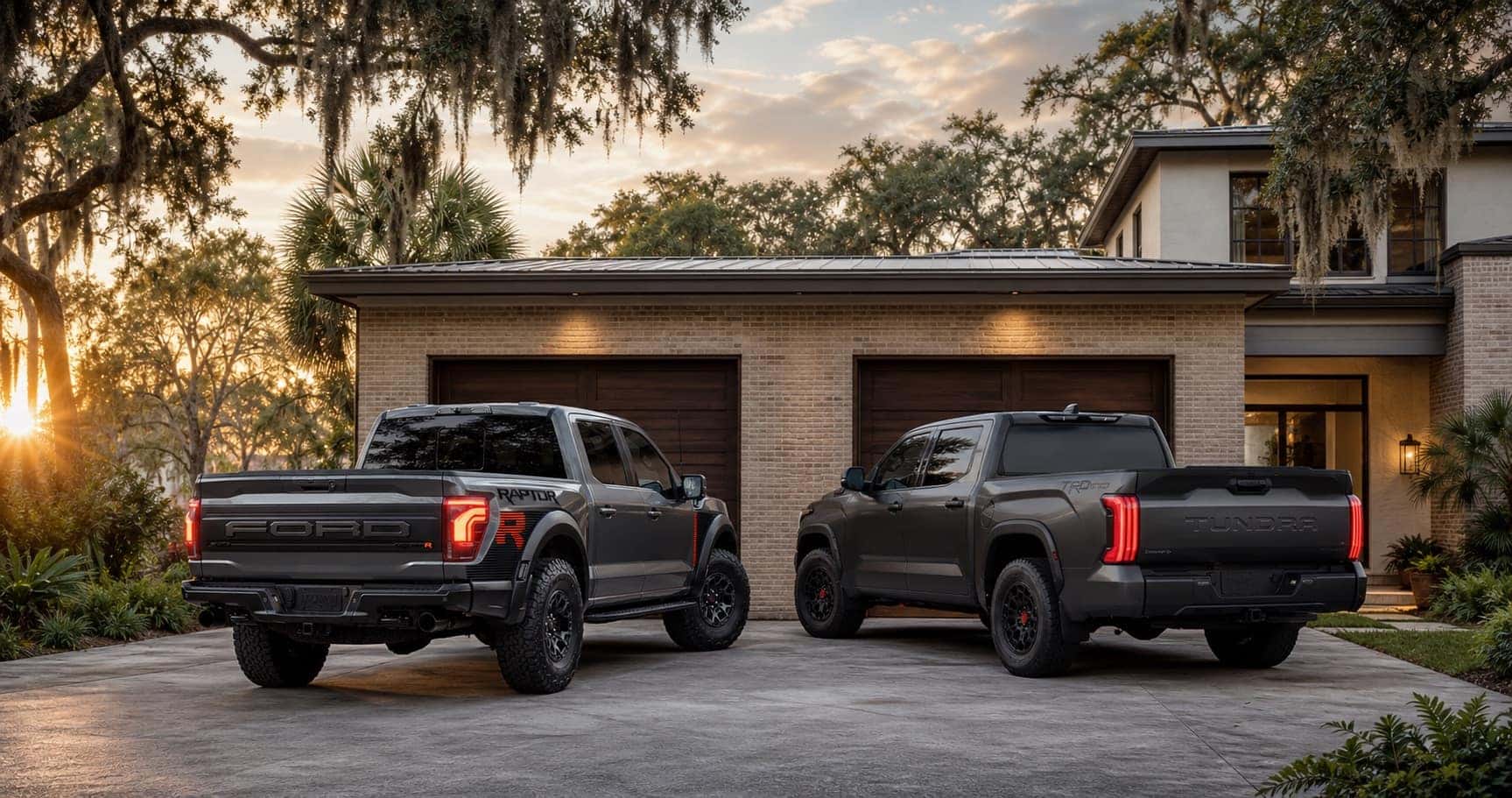
F-150's 13,500-pound maximum tow rating is 12.5% above Tundra's 12,000 pounds, while its 2,440-pound maximum payload is about 32% above Tundra's 1,850 pounds. If your trailer and truck load sit comfortably below the Tundra's limits, the maxima may never decide the purchase. As your real load approaches those ceilings, the F-150's extra margin becomes materially more useful. For rougher terrain, compare the actual Tremor or Raptor with the Tundra TRD configuration that fits the budget rather than treating either base truck as the off-road benchmark.
Technology & Comfort
Do You Value a Stronger Standard Screen Package, Hands-Free Highway Tech, or Tundra's Coil-Spring Ride?
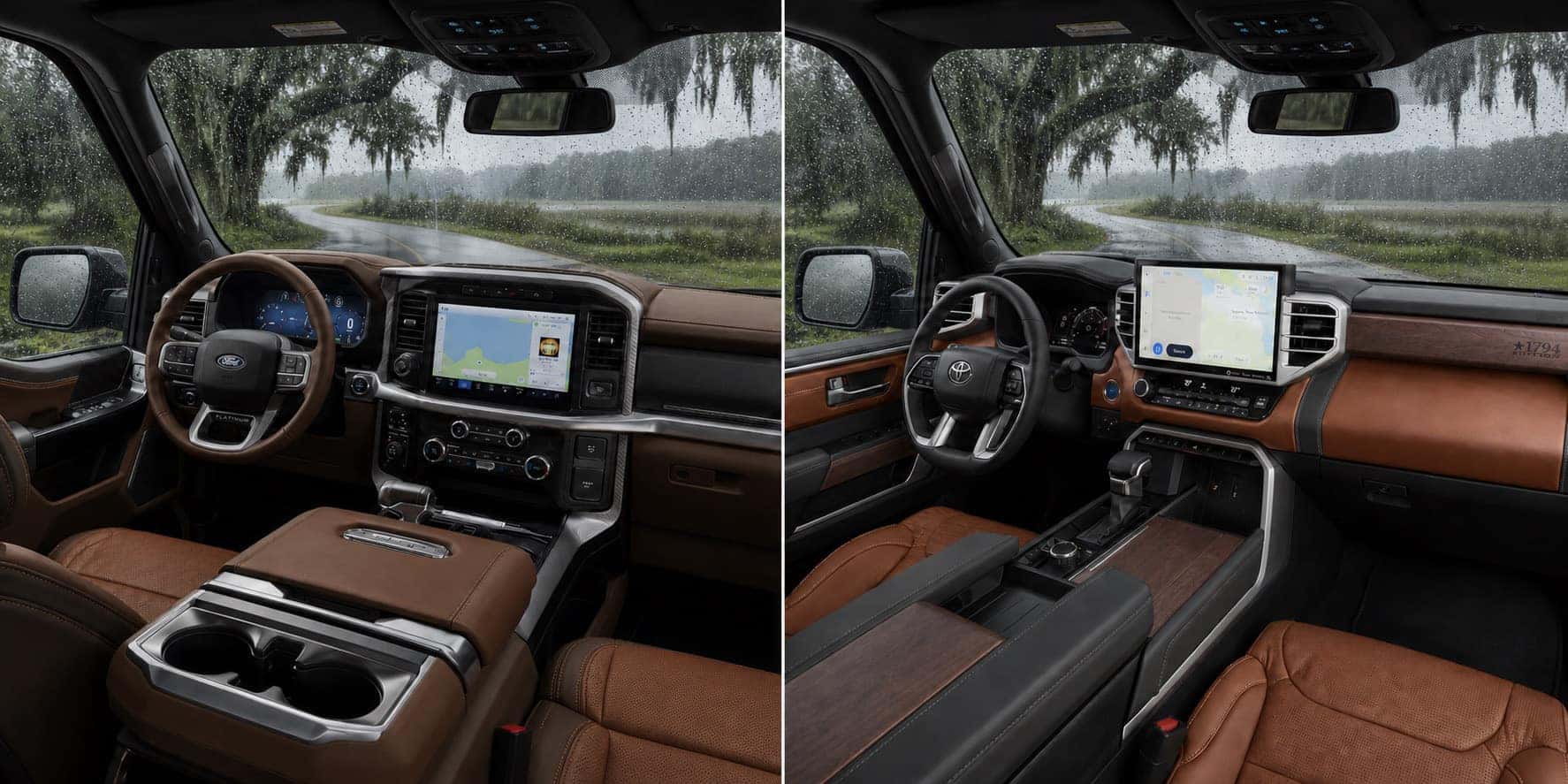
Technology is a genuine split rather than a one-way win. F-150 starts with a larger center screen and offers BlueCruise on eligible configurations. Tundra offers a larger available 14-inch screen and makes Toyota Safety Sense 2.5 standard, while its coil-spring rear suspension remains a notable comfort distinction.
2026 Ford F-150 vs 2026 Toyota Tundra — Technology & Comfort
Category
2026 Ford F-150
2026 Toyota Tundra
Center Touchscreen
12-in SYNC 4 touchscreen standard on XL
8-in standard / 14-in available Toyota Audio Multimedia
Phone Integration
Wireless Apple CarPlay & Android Auto
Wireless Apple CarPlay & Android Auto
Driver Assistance
Ford Co-Pilot360 technology Available: BlueCruise hands-free highway driving on eligible trims/equipment
Toyota Safety Sense 2.5 standard suite with driver-assistance features
F-150 Has the Larger Standard Screen; Tundra Can Go Larger and Has the More Distinct Ride Hardware
F-150 starts with a 12-inch center display and offers BlueCruise on eligible configurations, while Tundra starts at 8 inches but offers a 14-inch display. Screen size alone is unlikely to settle a full-size truck purchase. Tundra's coil-spring rear suspension creates the more consequential everyday difference here, so compare ride quality on the same route with the tire and suspension packages you would actually buy.
Trims, Pricing & Value
What Are You Paying More to Change—and What Ownership Support Comes With It?
The F-150 starts lower, but its entry truck is also a distinctly work-oriented Regular Cab configuration. The more useful value comparison is how each lineup lets you spend upward: more capability, powertrain choice, luxury, off-road hardware, or included ownership support.
2026 Ford F-150 vs 2026 Toyota Tundra — Trims, Pricing & Value
Category
2026 Ford F-150
2026 Toyota Tundra
Entry Starting Point*
XL — from $37,290 Regular Cab 4x2, 8-ft bed entry configuration
SR — from $41,260 Double Cab 4x2, 6.5-ft bed entry configuration
Reliability Scores Are Close; Ownership Support Splits in Different Directions
The basic and powertrain warranty periods are the same. J.D. Power rates both trucks Great for Quality & Reliability, with F-150 at 86 and Tundra at 83—a three-point difference that should be treated as supporting context, not a decisive reliability gap. Toyota also includes 2 years/25,000 miles of scheduled maintenance through ToyotaCare, while Ford's 5-year/60,000-mile roadside-assistance period runs longer than Toyota's 2-year/unlimited-mile coverage. Ownership value therefore splits across different advantages rather than pointing cleanly to one truck.
Independent Review Context
Car and Driver Prefers the F-150 Overall—But Its Ride Notes Strengthen the Tundra Case
Car and Driver rates the 2026 F-150 9/10, names it an Editors' Choice, and places it #3 in its current Best Full-Size Pickup Trucks ranking; the 2026 Tundra earns 8/10. That one-point rating gap supports F-150 as the publication's stronger overall pick, but the review language also sharpens a genuine Toyota advantage: Car and Driver praises Tundra's civilized coil-spring ride while listing F-150's stiff-riding rear suspension among its drawbacks.
Car and Driver
2026 Ford F-150
Rating
9 / 10
Recognition
Editors' Choice
Exceptional configuration breadth and competitive capability, with a rear-suspension ride tradeoff worth testing.
Car and Driver treats the F-150's range of engines, cabs, beds, and trims as one of its defining strengths and credits its towing and hauling capability. The review also calls out a stiff-riding rear suspension. That matters here because it prevents the F-150's higher rating from erasing the Tundra's strongest everyday counterargument: ride character can favor Toyota even when maximum capability and configuration breadth favor Ford.
A civilized ride, distinctive design, and enough trim variety to cover work, comfort, and off-road priorities.
Car and Driver specifically calls out the Tundra's coil-spring suspension for contributing to a more civilized ride and also recognizes the breadth of available trims. Those are useful strengths in this comparison: the Tundra does not need to match the F-150's maximum figures to be the better fit for a driver who values road comfort, a strong twin-turbo powertrain, and a more concentrated set of configurations.
Build the F-150 Around the Trailer, Payload & Cabin You Actually Need
Start with a realistic cab, bed, engine, drivetrain, and budget, then check passenger fit, bed access, visibility, ride, trailer-assist tools, and the payload label on the exact truck. The goal is not to reproduce the 13,500-pound or 2,440-pound headline maximums; it is to confirm that the configuration you would actually buy leaves enough margin for your passengers, cargo, and trailer without paying for capability you will not use.
Which Strength Will You Actually Use More Often Around Coastal Georgia?
The F-150 makes its strongest case when margin or configuration precision changes the job. Its towing ceiling is 1,500 pounds higher than the Tundra's, while the 590-pound payload advantage is the larger proportional gap. Those differences matter for heavier boats, equipment trailers, dense bed loads, or buyers who need a particular cab, seating, engine, or onboard-power setup. If your normal loads stay comfortably below the Tundra's limits, however, the F-150's headline maxima become less important than which exact configuration you prefer living with.
The Tundra becomes more compelling once its 12,000-pound towing and 1,850-pound payload ceilings already cover the work. Its hybrid has a small peak-output edge, the coil-spring rear suspension earns independent praise for ride comfort, the composite bed is standard, and ToyotaCare includes scheduled maintenance. In other words, Tundra does not need to beat Ford's maximum numbers to be the more attractive choice for a buyer whose everyday priorities sit elsewhere.
If Both Trucks Still Make Sense on Paper, Use the Fit Check to Identify the Tradeoff That Matters More.
3-Question Fit Check
Find Your Full-Size Truck Starting Point
Answer three questions about the truck job you repeat, what an upgrade budget should change, and what the final in-person comparison needs to prove.
Use these three questions as a decision checklist:
Would you use the F-150's extra towing, payload, cab, and engine range more often, or notice the Tundra's coil-spring ride and composite-bed strategy more?
If you spend more, should that money buy broader work capability and onboard power, or Tundra hybrid/off-road/comfort equipment?
Which same-route test is more likely to settle it: exact F-150 configuration fit or the Tundra's ride, controls, and bed/cab experience?
This fit check is a starting point, not a substitute for comparing the exact vehicles. Cab, bed, drivetrain, powertrain, equipment, payload, trailer weight, price, passengers, and real driving conditions can change which truck fits better.
Ford F-150 vs Toyota Tundra FAQs
Which can tow more, the 2026 Ford F-150 or Toyota Tundra?▼
The 2026 Ford F-150 has the higher published maximum at 13,500 pounds versus 12,000 pounds for the 2026 Toyota Tundra. That is a 1,500-pound, or 12.5%, difference. The extra ceiling matters most when your actual loaded trailer approaches the Tundra's limit; individual truck ratings still depend on engine, drivetrain, axle, cab, bed, equipment, passengers, and cargo.
Which has the higher maximum payload, F-150 or Tundra?▼
The F-150. Its 2,440-pound maximum available payload is 590 pounds, or about 32%, above the Tundra's 1,850-pound maximum. That is the larger proportional capability gap in this comparison, but the payload available on a specific truck can be much lower once cab, drivetrain, options, passengers, hitch equipment, and accessories are accounted for. Use the payload label on the exact truck you are considering.
Which hybrid is more powerful, the F-150 PowerBoost or Tundra i-FORCE MAX?▼
The Tundra i-FORCE MAX has the higher published peak output at 437 horsepower and 583 lb-ft of torque, compared with 420 horsepower and 570 lb-ft for the F-150 PowerBoost. The gaps are only 17 horsepower and 13 lb-ft, so peak output alone is not a large separator. PowerBoost's available Pro Power Onboard system adds a different utility advantage when mobile electrical power matters.
Why can the Toyota Tundra feel more comfortable on the road?▼
The conventional Tundra lineup uses a coil-spring multi-link rear suspension, while mainstream F-150 configurations use rear leaf springs. Suspension tuning, tires, wheel size, payload, and trim still affect how either truck rides, but Car and Driver specifically praises the Tundra's coil-spring setup for a more civilized ride and lists the F-150's stiff-riding rear suspension among its drawbacks.
How do warranty, reliability, and ownership support compare?▼
The core factory warranty is effectively a draw at 3 years/36,000 miles basic and 5 years/60,000 miles powertrain. J.D. Power's current Quality & Reliability scores are also close at 86 for F-150 and 83 for Tundra, with both rated Great. Tundra includes 2 years/25,000 miles of ToyotaCare scheduled maintenance, while Ford's published roadside assistance runs 5 years/60,000 miles compared with Toyota's 2 years/unlimited miles.
Which is better off-road, the F-150 or Tundra?▼
There is no useful one-answer verdict without naming the configuration. Ford offers F-150 Tremor and Raptor models with dedicated suspension, locking-differential, terrain, and trail-control hardware. Toyota offers the TRD Off-Road package and TRD Pro with its own off-road suspension, locking rear differential, Multi-Terrain Select, Crawl Control, and camera-based trail tools. Compare the specific packages and tires that fit the terrain you actually use.
Where can I shop a 2026 Ford F-150 near Savannah, GA?▼
J.C. Lewis Ford Savannah is located at 9505 Abercorn St in Savannah. Shoppers can review current F-150 inventory, compare engine, cab, bed, drivetrain, towing, and payload configurations, value a trade, explore financing, and test the Ford side of this comparison on a route that reflects their normal driving.
Shopping & Ownership Support
Turn the F-150 Side of the Comparison Into the Right Configuration
J.C. Lewis Ford has served the region since 1912 and remains a family-held Ford operation. That experience is especially useful with an F-150 because the same nameplate can change substantially with cab, bed, engine, drivetrain, axle, and towing equipment. Bring the trailer weight, passenger count, cargo assumptions, or work requirements that matter to you, then use the exact truck's payload label and configuration to determine how much real capacity margin remains—not just whether the brochure maximum looks high enough.
The Savannah team supports ordinary retail shoppers as well as commercial, fleet, specialty, and custom-truck buyers. Model-specific F-150 inventory, a vehicle-finder service, custom factory ordering, financing, payment, and trade tools can narrow the realistic choices before a visit. Remote transaction support and home delivery across the Southeast are also available for eligible purchases, which can be useful for shoppers coming from Richmond Hill, the Savannah islands, Bluffton, Hilton Head, Beaufort, or elsewhere in the region.
The ownership side continues through Ford service resources at J.C. Lewis Ford Savannah. Ford Pickup & Delivery and Ford Mobile Service are available for qualifying needs, subject to program availability, distance, scheduling, and service type. For a truck that may split time between work, towing, family travel, and Coastal Georgia recreation, those options can reduce the disruption of routine maintenance after the configuration decision is finished.
Where to Go Next
Start Shopping or Keep Researching
Ready to Shop?
Narrow the Ford side to the F-150 configuration you would actually own, then keep financing, payment, and trade assumptions consistent around that truck.
Go deeper into the F-150 side with model-specific research on specifications, towing, payload, dimensions, and trim structure before deciding which truck to drive.
Disclaimers:
*MSRP excludes destination and delivery, taxes, title, license, options, accessories, dealer-installed equipment, and dealer charges. Pricing, incentives, and availability can change. The two lowest-price configurations are not directly equivalent in cab, bed, drivetrain, or equipment.
*Horsepower and torque figures vary by engine and configuration and may require specified fuel. Confirm the exact powertrain before purchase.
*Towing and payload ratings require the specified engine, drivetrain, axle, cab, bed, towing equipment, tires, and proper loading. Passenger, cargo, hitch, accessory, and equipment weight reduce available payload and trailer capacity. Always use the certification and payload labels on the exact vehicle.
*Cab styles, seating, bed lengths, trailering technology, off-road hardware, driver-assistance features, displays, onboard power, tailgate features, and comfort equipment vary by trim, package, drivetrain, and configuration.
*Warranty and roadside coverage are subject to each manufacturer's new-vehicle warranty terms, time and mileage limits, exclusions, and eligibility. ToyotaCare covers normal factory-scheduled maintenance for 2 years/25,000 miles, whichever comes first, and roadside assistance for 2 years/unlimited miles, subject to program terms and exclusions.
*J.D. Power Quality & Reliability scores belong to J.D. Power and can change. Car and Driver ratings, recognition, rankings, and review conclusions belong to Car and Driver and can change.